Plantation deed transfer
Under Your Spell: A Romance Boxed Set of Masked Balls, Haunted Gardens, Magic, and MorePlantation deed transfer is the practical and symbolic act that breaks the Abbot–Moriarty family curse. Jade Abbot, the last living Abbot, gives the southern plantation back to Katrina Moriarty after learning that the Abbots acquired it through deception from the Moriartys. The transfer converts inherited guilt into deliberate restitution: instead of trying to survive the curse or preserve the property, Jade relinquishes the estate so that the grievance at its origin can finally be nullified.
Historical Cause and Family Curse
The transfer is rooted in a property dispute reaching back to the early nineteenth century. Gertrude Snodgrass explains that the Abbots did not purchase the plantation honestly from the Moriartys; they acquired it through trickery, possibly in a card game. The Moriartys had moved south from Salem, Massachusetts, and, after losing the plantation, cursed the Abbot family. The curse ensured that Abbot descendants generally lived only long enough to continue the family line before dying, turning the plantation into more than inherited property: it became the material source and continuing emblem of a feud between two bloodlines.
The curse’s design makes inheritance itself dangerous. Jade understands that the supernatural force needs an heir in order to continue, and that her position as the last living Abbot places both her survival and the future of the line at stake. Her grandparents’ funeral is only two days away, on October thirteenth, the anniversary of her parents’ funeral as well; October has repeatedly brought death to the Abbot family. Against that pattern, the deed transfer offers an alternative to preserving the house and reproducing the history attached to it.
The Transfer at the Notary
After discussing the curse, Jade takes Ryder Warren and Katrina Moriarty to a notary. The journey is deliberately unglamorous: Jade and Ryder hose themselves down after making his truck a wet mess, then arrive at the office to formalize the solution. Jade requests paper and writes a single sentence, reducing a history of deception, death, and supernatural retaliation to a legally actionable declaration.
Jade then asks Katrina how she feels about owning a southern plantation. Katrina’s surprise reflects the magnitude of the offer. Jade explains that her family cheated Katrina’s family out of the property and that the Abbot family was cursed as a result; returning the plantation to the Moriartys, she reasons, should make the original cause of the curse null. Ryder immediately recognizes the idea’s ingenuity, while Jade remains cautious about calling it a success before the supernatural consequences are tested.
The deed becomes binding through an ordinary legal procedure. A notary employee reads the paper, watches Jade Abbot and Katrina Moriarty sign it, and signs as a witness. The scene places legal formality beside magical causation: the notary does not perform an exorcism or a ritual, yet the witnessed document may accomplish what force and fear could not. Jade’s joking demand that Katrina pay her a dollar also gives the transaction a modest, almost domestic finish, sharply contrasting with the enormous ancestral burden being transferred.
Immediate Consequences and Release
The transfer changes Jade’s practical future as well as the supernatural one. Freed from the need to sink her savings into the plantation, she can look for another place to live and a new job. She considers moving anywhere, even back to New York, after the funeral. Although she will still have to repay the loan, she concludes that selling the property and escaping its obligations will actually save money. Restitution therefore becomes a form of self-preservation rather than a purely sacrificial gesture: Jade gives up the estate, but gains the possibility of an ungoverned life beyond the recurring danger of October.
The house itself provides the first test. Jade is nervous when she walks back inside with Ryder and Katrina, but nothing happens. They inspect the entire building, including the secret room Ryder discovered, and find no doors or windows opening by themselves, no cold air, and no other abnormal manifestation. The folders connected with the earlier mystery are gone, leaving an unresolved sign of supernatural or human intervention, but the house no longer behaves as the active center of the curse. Silence and normality become evidence that the transfer has altered the property’s power.
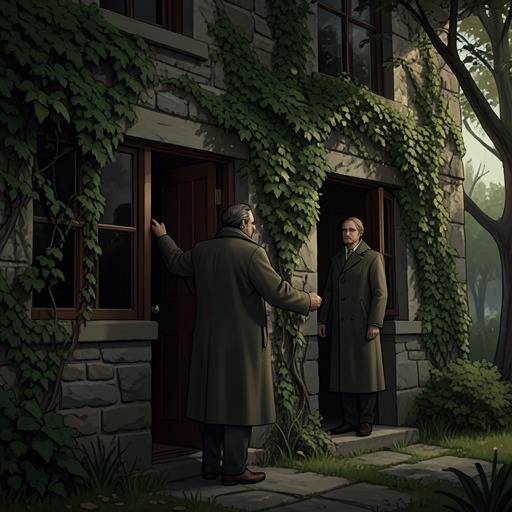
The final confirmation comes through an image of two men associated with the family history. One man stands before the house looking smug, while another hides behind a tree, appearing murderous; the image then changes, showing the two men arm in arm in front of the house. Jade guesses that the curse is over. Katrina confirms that peace has been brought between the two lines and regrets that so many Abbots died before the reconciliation occurred. Jade agrees that the deaths cannot be undone, but recognizes that the danger has ended and embraces Katrina, thanking both her and Ryder.
Restitution and Generational Repair
The deed transfer reverses the original act of acquisition. The Abbots’ gain came through trickery, and their possession preserved the conditions for the Moriarty curse; Jade’s voluntary surrender answers that wrong without reproducing its violence. The action is thus both a property transaction and a family settlement. It restores the dispossessed family’s claim, acknowledges the Abbot family’s responsibility, and transforms the plantation from contested inheritance into the basis of peace.
Its significance is heightened by Jade’s identity as the sole surviving Abbot. She is not merely transferring an asset on behalf of a secure family structure; she is ending the line’s relationship to the estate at the moment when the curse has reduced that line to one person. Her decision interrupts the pattern in which descendants live only long enough to produce heirs. Rather than treating bloodline continuity as an unquestioned duty, she chooses to stop feeding the history that has consumed her relatives.
The peaceful return to the house and the altered image of the two ancestral figures give the transfer its emotional and supernatural conclusion. The past does not disappear—Katrina still mourns the Abbots who died, and Jade still faces funerals and financial obligations—but its power to dictate the future is removed. The plantation deed transfer therefore functions as the book’s clearest image of repair through relinquishment: a wronged family receives what was taken, the guilty family’s surviving member escapes the inherited mechanism of punishment, and reconciliation becomes possible only after possession is surrendered.